







Key Takeaways
- Salesforce Manufacturing Cloud helps manufacturers improve forecasting, customer management, and operational visibility through connected data and smarter processes.
- Manufacturing CRM Salesforce capabilities support automation, better collaboration, and accurate insights for improved business decisions.
- A successful manufacturing cloud implementation connects systems, improves efficiency, and helps manufacturers achieve long-term growth.
What Is Salesforce Manufacturing Cloud?
Salesforce Manufacturing Cloud is a CRM solution for manufacturers. It helps manage sales agreements, forecasting, customer commitments, and operational data in one place.
What Manufacturing Cloud Is
Salesforce Manufacturing Cloud connects sales, operations, and production data. It helps teams track orders, actuals, and committed volumes for better planning.
How It Differs from Traditional CRM
Unlike traditional CRM, manufacturing CRM handles complex needs like sales agreements, demand planning, and ERP integration. It gives manufacturers better visibility into revenue and operations.
Industries That Use Manufacturing Cloud
Salesforce Manufacturing Cloud is used by industrial manufacturing, automotive, electronics, medical devices, and consumer goods companies to improve forecasting and customer management.
Why Manufacturers Need an Industry-Specific CRM
Manufacturers need specialized tools to manage customer commitments, supply planning, and production coordination. An industry-specific CRM improves visibility, forecasting, and business performance.
Common Challenges Manufacturers Face Without a Modern CRM
Inaccurate Sales Forecasting
Poor forecasting limits visibility into customer commitments, orders, and future demand. This often leads to missed revenue opportunities and inefficient planning.
Poor Customer Visibility
Without a single view, teams cannot track sales agreements, renewals, or customer history. This makes it harder to build strong, long-term relationships.
Disconnected Sales and Operations
When Sales and Operations work separately, planning becomes inconsistent. Misaligned data creates delays, inventory issues, and inaccurate forecasts.
Limited Partner Collaboration
Weak collaboration with partners reduces visibility into committed volumes and agreement performance. This affects forecasting and slows business decisions.
Manual Processes and Data Silos
Manual systems create data silos and limit forecast accuracy. Businesses spend more time correcting errors instead of improving customer experiences.
Key Features of Salesforce Manufacturing Cloud
Sales Agreements
Sales agreements help manufacturers manage long-term customer commitments with greater transparency. Teams can track planned volumes, revenues, and actual performance in one place.
Account-Based Forecasting
Account-based forecasting improves forecast accuracy using customer-specific demand and purchasing patterns. This helps businesses create better production plans and meet customer expectations.
Advanced Account Forecasting
Advanced forecasting compares projected demand with actual sales performance. It uses historical sales data and forecasting models for more reliable business planning.
Partner Relationship Management
Manufacturers can collaborate with distributors, vendors, and channel partners through connected workflows. Better information sharing improves coordination and customer service.
Manufacturing Intelligence and Dashboards
Real-time dashboards provide KPIs, manufacturing analytics, and business intelligence. Leaders gain better visibility into sales performance, planning, and operational efficiency.
AI-Powered Insights with Salesforce Einstein
Salesforce Einstein uses advanced analytics to predict market trends and future demand. It also identifies risks and recommends actions for better decision-making.
Mobile Access and Collaboration
Mobile access keeps teams connected from anywhere. Employees can securely access customer information, collaborate in real time, and respond faster to business needs.\

Benefits of Salesforce Manufacturing Cloud
More Accurate Revenue Forecasting
Salesforce Manufacturing Cloud combines historical data, orders, and customer commitments for better forecasting. This improves revenue planning and reduces forecasting errors.
Better Customer Relationship Management
Manufacturers gain a single view of customer accounts, agreements, and interactions. Better customer insights lead to stronger relationships and higher customer satisfaction.
Improved Sales and Operations Alignment
A connected platform keeps Sales and Operations working with the same information. Better collaboration improves production planning and business performance.
Faster Decision-Making with Real-Time Data
Real-time visibility into business processes helps teams make faster decisions. Leaders can respond quickly to market trends, risks, and customer demands.
Greater Visibility Across the Supply Chain
Connected data improves visibility across suppliers, channel partners, inventory, and production. This supports better resource planning and smoother order fulfillment.
Increased Productivity Through Automation
Automation reduces manual work by streamlining workflows, approvals, and service processes. Teams become more productive while improving operational efficiency and customer experience.
Manufacturing CRM Integration: Connecting Your Business Systems
Manufacturing CRM integration connects CRM with business systems to create one reliable data source. It improves visibility, reduces manual work, and supports faster decision-making.
ERP Integration
Connecting CRM with ERP systems like SAP, Oracle, and Microsoft Dynamics synchronizes orders, pricing, and production data. Sales teams gain real-time visibility into order status and delivery timelines.
Inventory and Supply Chain Systems
Integration keeps inventory levels, shipping updates, and product availability synchronized. This improves production planning and helps prevent stock shortages or delays.
Accounting Platforms
Accounting integration connects pricing, invoices, and financial records with CRM. Accurate data supports better reporting and stronger customer relationship management.
Marketing Automation Tools
Marketing tools share customer insights, campaign performance, and opportunities with CRM. This helps sales teams engage prospects more effectively and improve conversions.
API and MuleSoft Integrations
APIs and MuleSoft connect CRM with existing systems through secure data synchronization. This improves operational visibility, workflow automation, and manufacturing efficiency.
Manufacturing Cloud Implementation: Step-by-Step Guide
Step 1: Define Business Objectives
Identify clear goals before implementation begins. Align Salesforce Manufacturing Cloud with business operations, sales planning, and revenue forecasting.
Step 2: Assess Existing CRM and ERP Data
Review existing CRM and ERP data for accuracy and completeness. Clean customer accounts, orders, and historical sales data before migration.
Step 3: Configure Manufacturing Cloud
Configure sales agreements, forecasting, objects, fields, and approval workflows. Customize the platform to match your manufacturing processes.
Step 4: Integrate Business Applications
Connect ERP, accounting, and partner systems with Salesforce Manufacturing Cloud. Integration improves operational visibility and supports seamless collaboration.
Step 5: Migrate and Validate Data
Transfer customer, product, pricing, and order data carefully. Validate migrated information to maintain data accuracy and consistency.
Step 6: Train Users
Train sales teams, managers, and account managers before launch. Practical training improves user adoption and daily productivity.
Step 7: Test Before Going Live
Test workflows, forecasting, reports, and integrations thoroughly. Resolve issues before deployment to ensure a smooth launch.
Step 8: Measure Performance and Optimize
Track forecast performance, user adoption, and business results after launch. Use insights to optimize processes and continuously improve the platform.

Common Manufacturing Cloud Implementation Challenges
Poor Data Quality
Poor customer and business data reduce forecast accuracy and decision-making. Clean and validate data before migration to ensure reliable results.
Resistance to User Adoption
Employees may hesitate to use a new system without proper guidance. Ongoing training and change management encourage faster adoption.
Complex ERP Integration
Integrating ERP with existing systems can be challenging. Careful planning and data mapping help ensure seamless integration.
Inaccurate Forecasting Models
Weak forecasting models can lead to poor planning and inventory issues. Regularly refine forecasts using historical data and actual demand.
Lack of Executive Buy-In
Limited leadership support can slow implementation and decision-making. Clear business goals help secure executive commitment.
Insufficient Training
Without proper training, users struggle to use the platform effectively. Continuous learning improves confidence and long-term success.
Best Practices for Successful Salesforce Manufacturing Cloud Deployment
Keep Customer Data Clean
Maintain accurate customer data by removing duplicate and outdated information. Strong data governance improves reporting and decision-making.
Standardize Sales Processes
Use consistent workflows and standardized processes across sales teams. This improves collaboration and keeps operations aligned.
Automate Repetitive Tasks
Automate routine workflows and approvals to reduce manual work. This increases productivity and operational efficiency.
Use AI Forecasting Regularly
Use AI-powered forecasting to analyze historical data and predict demand. Regular forecasting supports better planning and resource allocation.
Build Executive Dashboards
Create dashboards that display KPIs and operational insights in real time. Leaders can make faster decisions using reliable business data.
Continuously Improve User Adoption
Provide ongoing training, collect feedback, and support users after deployment. Continuous improvement helps teams get the most from the platform.
Salesforce Manufacturing Cloud vs Traditional Manufacturing CRM
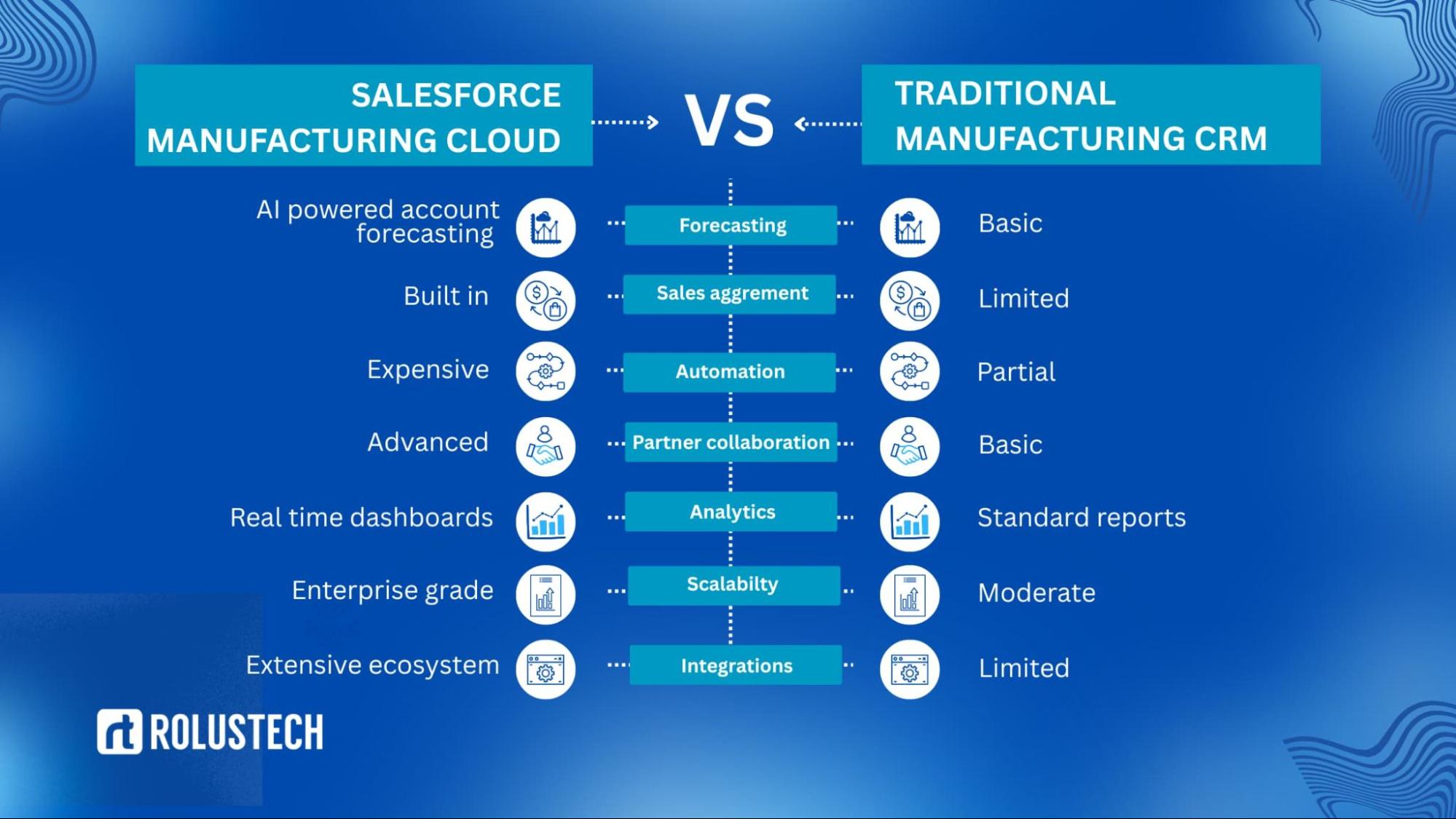
Manufacturing CRM Salesforce offers advanced features designed for complex manufacturing operations. Traditional CRM works for basic sales, while Manufacturing Cloud supports forecasting, production, and long-term customer relationships.
How to Measure ROI After Implementing Salesforce Manufacturing Cloud
Forecast Accuracy
Monitor forecast accuracy by comparing projected demand with actual sales. Better accuracy supports smarter production and inventory planning.
Revenue Growth
Measure revenue growth after implementation to evaluate business impact. Higher sales and stronger customer relationships indicate positive ROI.
Sales Productivity
Track deals closed, sales cycle length, and revenue per representative. Increased productivity shows teams are using the platform effectively.
Customer Retention
Measure repeat purchases, renewal rates, and customer retention. Strong retention reflects better customer engagement and long-term value.
Order Fulfillment Efficiency
Monitor on-time deliveries, order accuracy, and fulfillment times. Improved efficiency reduces costs and increases customer trust.
Customer Satisfaction Scores
Track CSAT, customer feedback, and support response times. Higher satisfaction scores indicate better service and stronger customer experiences.

Why Partner with an Experienced Salesforce Manufacturing Cloud Consultant?
Faster Deployment
An experienced partner follows proven implementation processes and avoids common mistakes. This reduces delays and helps businesses start seeing value sooner.
Industry Expertise
A Salesforce implementation consultant understands manufacturing requirements and business goals. Their knowledge helps deliver solutions that match industry needs.
Custom Integrations
Consultants build tailored integrations with ERP and other business systems. This improves workflows, data management, and operational efficiency.
Ongoing Support and Optimization
Continuous support, training, and optimization keep the platform performing at its best. Regular improvements help maximize productivity and accelerate return on investment.
Conclusion
Salesforce Manufacturing Cloud improves forecasting, customer management, automation, and operational visibility from one connected platform. It helps manufacturers make smarter decisions and improve overall business performance.
Rolustech provides expert Salesforce Manufacturing Cloud consulting, implementation, customization, integration, migration, and ongoing support. Our team helps manufacturers deploy the right solution and achieve faster ROI.
Frequently Asked Questions
What is Salesforce Manufacturing Cloud?
Salesforce Manufacturing Cloud is a CRM designed for manufacturers. It helps manage sales agreements, forecasting, and customer relationships.
How does Manufacturing Cloud improve manufacturing forecasting?
It combines customer commitments, orders, and historical data to improve forecast accuracy and planning.
Is Salesforce Manufacturing Cloud suitable for small manufacturers?
Yes. It helps small manufacturers automate processes, improve visibility, and support business growth.
What systems can Manufacturing Cloud integrate with?
It integrates with ERP systems, accounting software, marketing tools, and third-party applications.
How long does manufacturing cloud implementation take?
Implementation usually takes a few weeks to several months, depending on project complexity.
What is the difference between Salesforce Manufacturing Cloud and Sales Cloud?
Manufacturing Cloud includes manufacturing-specific features, while Sales Cloud focuses on general sales management.