







Key Takeaways
- AI-enabled CRM goes far beyond chatbots. It uses automation, predictions, and data intelligence to improve sales, marketing, and customer service.
- Modern AI CRM analyzes customer behavior and recommends the next best action. This helps businesses save time, personalize experiences, and make smarter decisions.
- Successful AI CRM implementation depends on clean data, skilled teams, and continuous improvement. Companies that combine AI with human oversight achieve better long-term results.
What Is an AI-Enabled CRM?
An AI-enabled CRM uses artificial intelligence to automate tasks, analyze customer data, and improve decisions. It helps businesses work smarter across sales, marketing, and customer support.
Traditional CRM vs AI-enabled CRM
A traditional CRM stores customer information and tracks activities. An AI CRM adds machine learning, predictive analytics, and CRM automation to predict outcomes and improve productivity.
How artificial intelligence changes CRM capabilities
Artificial intelligence transforms CRM by finding patterns in data and automating routine work. It delivers better customer insights, forecasting, and personalization for faster business decisions.
Why chatbots are only one small feature
Chatbots are only one part of an AI-powered CRM. The real value comes from AI capabilities like lead scoring, workflow automation, forecasting, and intelligent recommendations.
How AI Works Inside Modern CRM Systems
AI in CRM transforms everyday CRM activity into smart decisions and automated actions. It analyzes customer data, understands context, and improves every interaction without adding more manual work.
Machine learning for customer predictions
Machine learning learns from past interactions, behavioral patterns, and CRM data. It improves lead scoring, sales forecasting, and AI-driven forecasting while helping teams predict customer behavior more accurately.
Natural language processing (NLP)
Natural language processing (NLP) understands emails, chat messages, call transcripts, and support tickets. It extracts valuable customer insights, improves communication, and supports better decision-making.
Generative AI for content creation
Generative AI creates follow-up emails, call summaries, and personalized replies using customer relationships and retained context. This reduces manual effort, supports CRM automation, and boosts sales productivity.
Predictive and prescriptive analytics
Predictive intelligence uses AI models, forecasting models, and customer behavior to predict future outcomes. Prescriptive analytics then recommends the next best action to improve engagement and sales results.
CRM data intelligence explained
CRM data intelligence combines CRM signals, real-time actions, and continuous learning into one unified view. This enables AI CRM software to automate workflows, strengthen customer engagement, and deliver better business decisions.
Core Features of an AI-Enabled CRM Beyond Chatbots
An AI-powered CRM does much more than answer customer questions. It combines automation, intelligence, and predictive analytics to improve sales, marketing, and customer experiences.
AI-powered lead scoring
AI-powered CRM systems use machine learning and customer behavior to rank leads automatically. This helps sales teams focus on high-value leads with stronger conversion potential.
Opportunity and revenue forecasting
AI analyzes historical data, sales activity logs, and market trends to predict future opportunities. Better sales forecasting and revenue forecasting help businesses make confident decisions.
Automated email generation
AI creates personalized emails using customer data, previous interactions, and relationship history. This saves time while improving communication and customer engagement.
Smart follow-up recommendations
An AI CRM tracks engagement and suggests the best follow-up time and message. These recommendations increase response rates and keep deals moving forward.
Customer sentiment analysis
Using natural language processing (NLP), AI studies conversations, emails, and messages to understand customer emotions. Teams can respond faster and improve the overall customer experience.
Intelligent workflow automation
CRM automation with AI handles repetitive tasks like lead routing, task assignment, and automated data entry. This improves productivity while reducing manual work and human error.
AI-powered meeting summaries
AI automatically converts meetings and call notes into clear summaries with action points. This keeps sales reps informed without spending extra time on documentation.
CRM AI agents for repetitive tasks
CRM AI agents work like intelligent assistants that manage routine activities throughout the day. They schedule meetings, update records, qualify leads, and support teams through smart workflow automation.

Real Business Benefits of AI-Enabled CRM
An AI CRM helps businesses work faster, serve customers better, and make smarter decisions.
Faster sales cycles
An AI-powered CRM automates lead scoring, follow-ups, and reminders to speed up every deal. Sales teams spend less time on manual work and more time closing opportunities.
Higher conversion rates
AI studies customer behavior, engagement patterns, and historical data to identify promising leads. This improves targeting and increases conversion rates through personalized engagement.
Better customer experiences
AI delivers personalized customer experiences across email, web, and other channels. Faster responses and relevant recommendations improve satisfaction and build long-term loyalty.
Increased employee productivity
Intelligent automation handles repetitive tasks like data entry, scheduling, and workflow updates. Employees gain more time for relationship building and higher-value work.
Improved business decisions with AI insights
AI transforms customer data into meaningful insights using business intelligence and predictive models. Organizations can make faster, data-driven decisions that support sustainable business growth.
How Different Teams Use AI-Enabled CRM
AI CRM solutions help every team work smarter with automation, insights, and faster decisions. Each department uses AI differently to improve productivity and customer outcomes.
Sales teams
Sales teams use AI for lead scoring, pipeline recommendations, and next-best actions. This improves sales forecasting and helps close deals faster.
Marketing teams
Marketing teams use AI for audience segmentation, campaign optimization, and personalized content. This increases customer engagement and campaign performance.
Customer service teams
Customer service teams use AI to prioritize cases, answer customer queries, and suggest relevant knowledge articles. This improves response times and customer satisfaction.
Leadership teams
Leadership teams use AI for forecasting, revenue insights, and performance dashboards. These insights support smarter decisions and business growth.
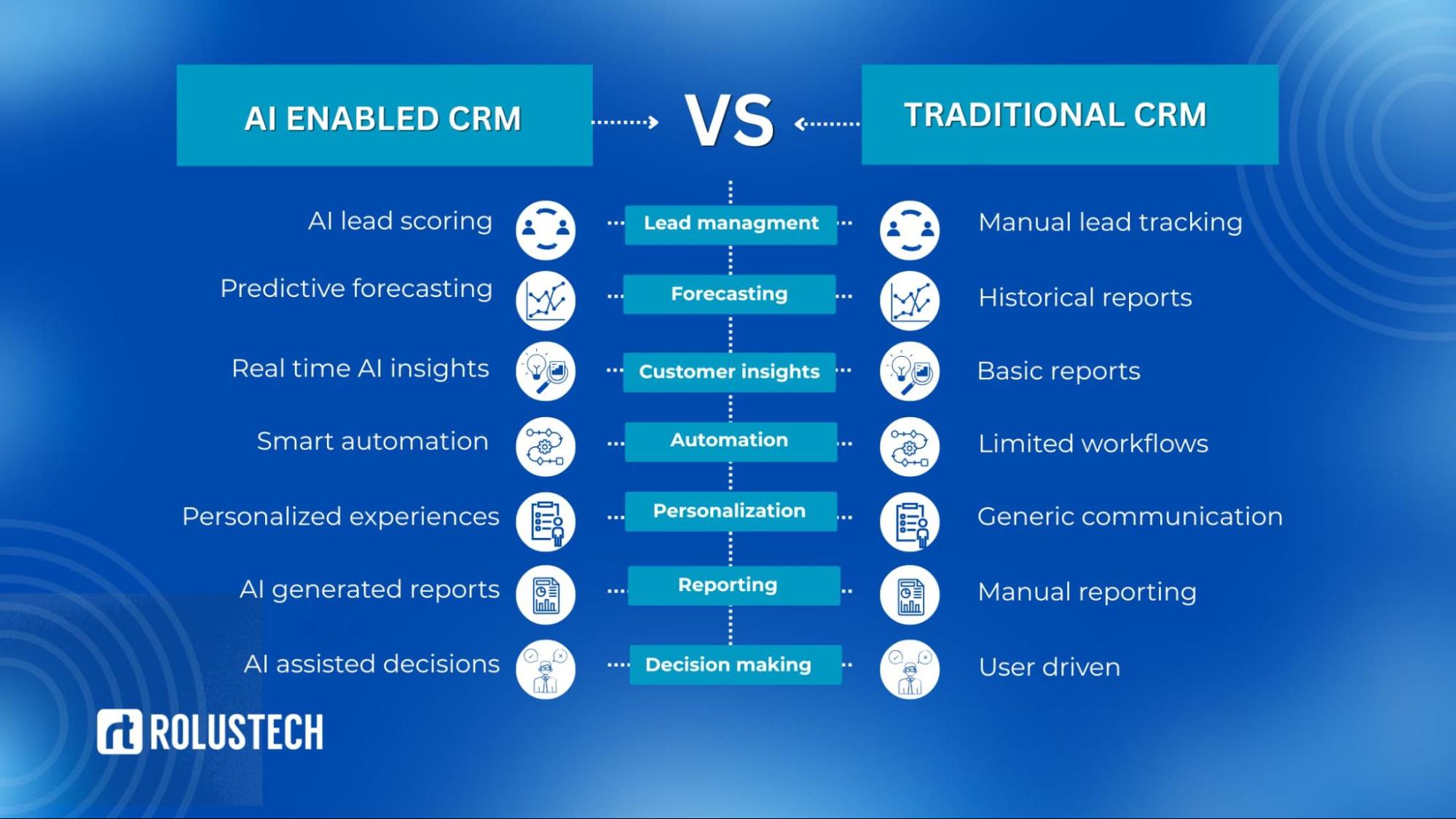
AI CRM vs Traditional CRM: Feature Comparison
An AI CRM automates work and delivers smarter insights, while a Traditional CRM mainly stores customer data. The comparison below highlights the key differences.
Common AI Technologies Powering Modern CRM
Artificial intelligence in CRM combines several technologies to automate work, improve decisions, and deliver better customer experiences.
Machine learning
Machine learning analyzes historical data and customer behavior to improve predictions, lead scoring, and sales forecasting.
Generative AI
Generative AI creates emails, meeting summaries, and sales content using CRM data and customer context.
Natural language processing (NLP)
Natural language processing (NLP) understands conversations, emails, and call transcripts. It converts unstructured data into useful customer insights.
Predictive analytics
Predictive analytics identifies trends, forecasts revenue, and highlights opportunities using AI models and historical patterns.
AI agents and autonomous workflows
AI agents automate routine tasks, execute workflows, and support decisions across multiple systems. They reduce manual work while improving productivity.
How to Successfully Implement an AI-Enabled CRM
A successful AI CRM implementation starts with clear planning, quality data, and user adoption. Following the right steps helps businesses achieve better results faster.
Assess current CRM maturity
Review your existing CRM software, workflows, and business challenges. Identify gaps before starting AI integration.
Prepare and clean customer data
Clean customer data, remove duplicates, and update CRM records. High-quality data improves AI accuracy and predictions.
Choose AI features based on business goals
Select AI tools that match your business goals and solve real operational challenges. Prioritize features with the highest business impact.
Train employees
Provide training sessions and onboarding so teams understand new AI features. Strong user adoption leads to better productivity and collaboration.
Measure ROI and continuously optimize
Track ROI, success metrics, and customer outcomes after implementation. Use feedback to optimize workflows and improve long-term performance.
Challenges Businesses Face When Adopting AI CRM
While AI CRM services deliver significant benefits, successful adoption requires the right strategy and preparation. Addressing these challenges helps businesses maximize long-term value.
Poor data quality
Incomplete CRM data, duplicate records, and outdated information reduce AI accuracy. Clean, high-quality data is essential for reliable predictions.
User adoption issues
Employees need proper training to use AI tools confidently. Strong onboarding and continuous support improve AI adoption across teams.
Privacy and compliance concerns
Businesses must protect customer data and meet privacy and compliance requirements. Clear data governance builds trust and reduces risk.
Integration with existing systems
Connecting AI with legacy CRM architecture and third-party applications can be challenging. Smooth CRM integration ensures consistent workflows and data.
Managing AI accuracy and bias
Teams should monitor AI models and review AI outputs regularly. Ongoing audits and feedback improve accuracy, reduce bias, and support better decisions.

Future Trends Shaping AI-Enabled CRM
The future of AI-powered sales CRM is more intelligent, proactive, and personalized. New AI technologies will help businesses automate more tasks while improving every customer interaction.
Autonomous CRM AI agents
Autonomous AI agents will manage routine tasks, recommend actions, and complete workflows with minimal human input.
Hyper-personalized customer journeys
AI will use customer insights and behavior to deliver personalized experiences at every stage of the customer journey.
Voice-first CRM assistants
Voice-enabled assistants will use speech recognition to update CRM records, answer questions, and support sales teams hands-free.
Predictive customer success
Predictive analytics will identify customer needs, reduce churn, and recommend proactive actions before issues arise.
Real-time AI decision-making
Future AI-powered CRM systems will analyze live data and deliver instant recommendations for faster, smarter business decisions.
Conclusion
An AI-enabled CRM is far more than a chatbot. It uses AI to improve sales, marketing, customer service, and decision-making through automation, insights, and personalization. With clean data and clear goals, businesses can achieve better results and stronger customer relationships.
Rolustech helps businesses adopt AI with confidence through expert AI CRM services, implementation, customization, and integration. Whether you’re upgrading an existing CRM or starting fresh, our team can build an AI-powered solution that supports long-term growth.
Frequently Asked Questions
What is an AI-enabled CRM?
An AI-enabled CRM uses AI to automate tasks, analyze customer data, and improve business decisions.
How is an AI-powered CRM different from a chatbot?
A chatbot is one feature, while an AI-powered CRM automates sales, marketing, service, and workflows.
What are the benefits of AI in CRM?
AI in CRM improves productivity, customer experiences, forecasting, and decision-making through automation.
Can small businesses use AI CRM software?
Yes. AI CRM software helps small businesses automate tasks and grow more efficiently.
What are CRM AI agents?
CRM AI agents automate routine tasks, manage records, and recommend the next best actions.
How long does AI CRM implementation take?
Most AI CRM implementation projects take a few weeks to a few months, depending on complexity.